
Those of us that have been unfortunate enough to suffer sexual violence, know just how horrific an event like this actually is, and then what comes afterwards is no easy journey for us. Some of us may choose to keep the crime to ourselves, and some of us may report it, but whatever option we go for, we will all suffer some form of emotional and psychological trauma in consequence of the assault/s.
I can only speak for myself when i say this, but when i was attacked i think my first reaction was just complete shock. I couldn’t believe nor comprehend that the person i loved was attacking and raping me. But even after the attack, i was still in utter disbelief that this had happened. Was it real? Is it real? Soon the disbelief turned to sorrow and turmoil, which was then followed by self–blame and despair. Then the fear, the panic, and the anxiety would creep in, followed by disillusionment, anger and pain. All these emotions in addition to the nightmares, the flashbacks, and the suicidal thoughts, was almost too much to bear. I was in a fog of confusion and hurt, i didn’t even know where to begin in trying to heal, and if i’m completley honest, i couldn’t see that far ahead. I was so depressed and scared that i locked my self away for weeks. I didn’t think that i would ever smile and laugh again, and i thought…all that remained for me now, was dark thoughts and low moods, but i’m very happy to say….i was wrong! Friends…with the right tools and support, in time, we can recover, and we will recover😁❤️.
Life is by no–means straight–forward and easy, it’s not meant to be. Life’s not always full of the joys of spring, happiness, and sweet, sweet laughter. Nope…in life we suffer much heartache, we face many tragedies, and we lose our nearest and dearests, and in life, some of us will carry many burdens, endure many pains, and weep many sorrows.
It’s often a catalytic event such as the loss or death of a loved one, or being the victim of violence or sexual violence, that triggers the unravelling of our psyche and our emotions. Some of us may sink into a deep depression, or some of us may engage in dangerous and destructive behaviours, and some of us, will be plagued by an onset of suicidal thoughts, and/or have the urge to harm ourselves. As horrible as it sounds, these are relatively normal/common reactions to have upon being a victim/survivor of sexual violence, or after losing a loved one, that being said however, whilst it’s important to feel what we feel (our heartache, our grief, our pain), it’s not always healthy and can be dangerous without the right support and guidance. We must therefore, at some point (when we’re ready to), begin the process of healing in a healthy and managable manner, so that we may go on to live full and happy lives.
When we’re in the midst of a tradgedy or heartbreak, take for example the ending of a long–term relationship or the loss of a loved one, the last thing we want to hear, or we can even begin to comprehend is, a friend or family member telling us to move on and get over it, or that they’re at peace now and in a much better place. When we’re in the stages of sadness or grief, or when we’re in the deep grip of hurt, fear or anger, we fail to see the possibilty of ever recovering from the pain of our fractured hearts, or that our broken psyche can, or will, ever be repaired. We don’t think we’ll ever feel love, or ever love again, all there is for us in that moment and thereafter…is darkness.
The twists and turns of having to navigate all these fleeting emotions and dark thoughts so that we can begin the process of healing, can be, and at times is, difficult, daunting, and a long and winding journey of tremendous feats, and discerning hurdles, that will, on some days, put us on the highest of highs, and others, the lowest of lows. It’s a journey of pain, and a journey of facing our fears. It’s a journey of self–love, of self–discovery, and of growth. There will be days when it feels like your world is crumbling around you, on days like this, healing is not something you can envision, it doesn’t even come to mind. You’re numb to your true feelings, or you’re red with anger because of the injustice you have suffered, or sometimes, you shake uncontrollably because the fear that overwhelms you has it’s grip on you tightly. Most days you panic unneccasarily, because you live in a state of constant hypervigilance, always anticipating the next threat (whether there’s a threat or not). Our logic becomes overpowered by irrationality, and our hearts become hardened like stone…inpenetrable to the sharp swords of love because we’ve suffered from so much heartbreak. What i’m trying to say is, that when we suffer such losses, or when we’re the recipent of brutal violence, the event will have a significant impact on our psyche and emotions, and we will suffer some trauma in consequence of this, which will, in turn, affect our relationships and our everyday lives. But…although we can’t change what happened to us, ‘we can change our story’ (thisishowyouheal). We shouldn’t have to live like this, in fear and darkness, we deserve to smile, we deserve to be happy, and we deserve to live…and we do this by healing.
Healing…
- Healing is a process that doesn’t happen linary or seamlessly.
- Healing is a journey.
- Healing is not a one-time event (though it can start with one).
- Healing is a moment of reconciliation with ourselves.
- Healing is a place for growth and soul-development.
“The true work of healing is allowing that disruption to wake us from a deep state of unconsciousness, to release the persona we adapted into being, consciously piecing together the full truth of who we were meant to be“.
Brianna West
The affect healing has on us…
- Healing allows us to reconnect and harmonise our bodies, thoughts and emotions.
- Healing ourselves can extend that healing outwards.
- We embark upon a journey of our own becoming (our true-selves, our destiny).
- We establish new grounded perspectives and recalibrate our mindset.
- Healing allows for soul-development, growth, and wisdom.
- Healing is couragous and allows us to be self-sufficient.
- Healing allows us to press forward so we can live more intently and presently.
- We start speaking, we begin to socialise, we start to feel again, we become who we were meant to be all along.
- Healing allows us to start a new-beginning, a new chapter in our lives.
- Healing allows us to love ourselves.
- Healing is letting go of negative thoughts and emotions.
- Healing allows us to reclaim our inner strength, and take our power back.
“A greater life is pressing to be born“.
Michael Murphey
Steps to Recovery…
The most important thing to do immediately after the assault/attack, is to report the crime to the police, but only if and when it’s safe for you to do–so. This is not only to protect yourself (stop this happening to you again by the same perpertrator), but reporting the crime will also protect other potential victims.
If you report the crime/s to the police, they will refer you to the specialised support services that can, and will, assist, help, and advise you throughout the investigaton and thereafter. However, i completley understand that not everbody will be comfortable contacting the police, whether it’s because of the fear you feel, or maybe it just doesn’t feel like it’s the right time for you to report it, that’s perfectly fine, i’m not here to push you into anything you’re not ready for.
Being the victim/survivor of any form of sexual violence has a devastating impact on us mentally, physically, and emotionally, and each of us will have different experiences, reactions, and responses to it. The decision is yours, and yours alone, but i want you to know that ‘YVM‘ is here for you no matter how you choose to proceed ❤️. Also, there’s an abundance of resources and support services that you can access, use, and engage with if you decide that reporting the crime isn’t the right step for you at this time.
Useful Tools & Coping Strategies
Emotional regulation;
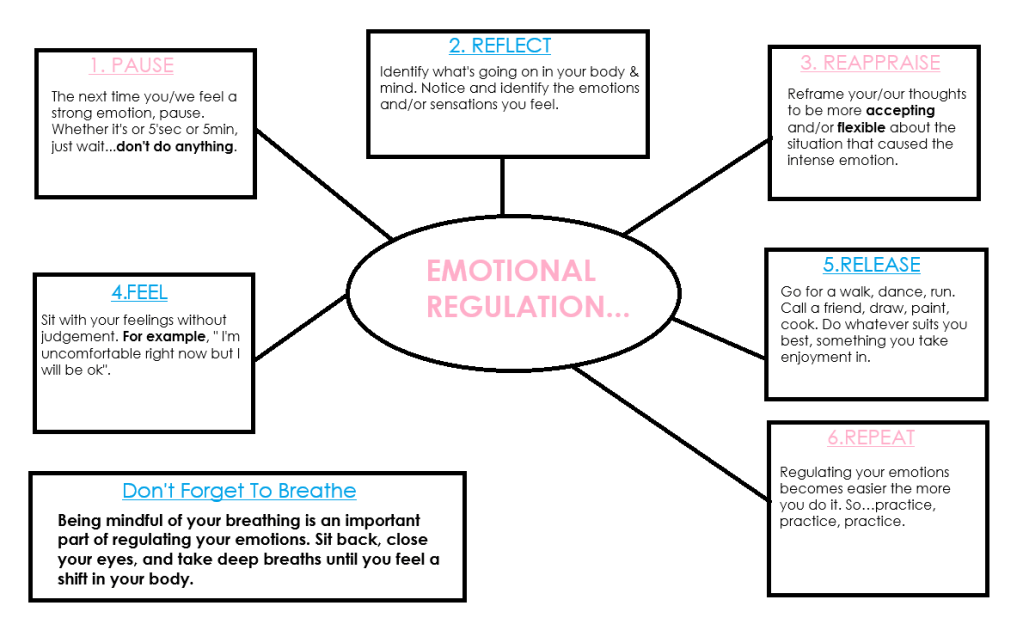
Breathing
I find deep breathing to be a very useful technique because it calms my mind and my soul. When i feel the stress levels rising in me, or when i feel my blood boiling, deep breathing brings me a sense of serenity and peace within myself.
Deep breathing helps to slow our pulse, inducing calm and relaxation. It does this by activating the vagnus nerve ‘which controls the parasymphatic nervous system‘ (workshop notes 2020). It returns us to a ‘state of equlibrium‘. There are a variety of breathing techniques such as, box breathing, hand breathing and the 4-7-8 method.
The link below explains the benefits and the science around breathing techniques in greater detail.
https://www.healthline.com/health/box-breathing
Grounding Techniques
Grounding is a useful coping strategy designed to immediately connect us to the present moment. It’s used by people suffering with trauma as a way of coping with dissociation and/or flashbacks. It helps distract and cope with upsetting thoughts, feelings, and memories, and because of ‘it’s focus on the present moment it can be considered as a variant of mindfulness‘ (workshop notes 2020)
Grounding is useful when;
- When we feel ourselves becoming overwhelmed, and/or distracted by feelings, thoughts or memories.
- We’re caught up in strong emotions such as: anger, anxiety, engaged in repetative stressful thoughts.
- Experiencing a strong painful memory and/or flashbacks.
- Waking from nightmares with a racing/pounding heart.
Grounding exercises bring us ‘back down to earth’.
Grounding uses 5 senses: smell, taste, touch, sight, and sounds.
Smell;
- Light a scented candle or melt scented wax.
- Sniff strong peppermint which also has the benefit of having a soothing affect.
- Get some relaxing essential oils and smell them.
Taste;
- Suck on a mint or chew peppermint gum.
- Bite or suck a lemon or lime.
- Take a bite of something spicy or peppery.
- Let a piece of chocolate melt in your mouth, noticing how it feels and tastes as you roll it around your tongue.
Sight;
- Play a distracting game on your phone, computer or tablet.
- Put on your favourite tv or movie show.
- Read a book or magazine.
- Take a mental inventory of everything around you i.e. colours and patterns around you. Saying them aloud is a helpful too.
- Complete a crossword puzzle, a jigsaw puzzle, sudoku, wordsearch or other puzzles.
Sound;
- Listen to the radio, or your favourite song.
- Call a loved one.
- Read out loud.
- Talk out loud about what you see, hear or of what you are thinking of doing.
Touch;
- Hold an ice cube and let it melt in your hand.
- Rub your hand lightly over the carpet or furniture. Take notice of the texture.
- Massage your temples.
- Take a hot or cool shower.
- Put your hands under running water.
- Drink a hot or cold beverage.
- If you’ve got a dog or a cat, cuddle and pet them.
Other;
- Creative Expression: art, journaling, music or movement to process emotions that are difficult to put into words.
- Somatic Awareness: physical movement such as stretching and yoga. To help relieve tension.
- Community Spaces: participate in survivor-focused/centred environments were we feel supported, believed and understood.
- Establishing Routines: maintain small predictable routines and habits to restore a sense of stability and order.
https://www.healthline.com/health/grounding-techniques
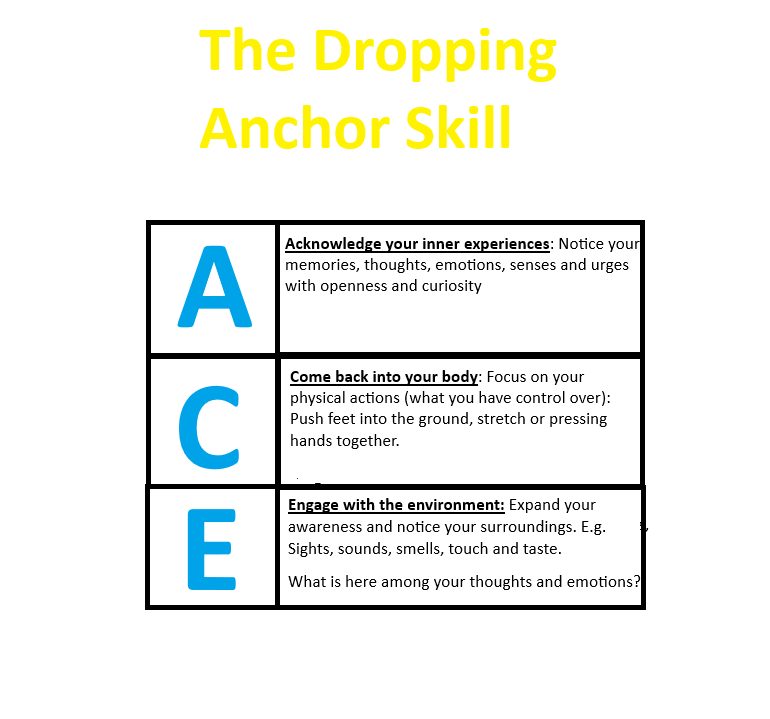
The Dropping Anchor Skill (acceptance and commitment therapy)
This tool is useful when you/we are feeling;
- You want to ground yourself in order to access another skill (acceptance, defusion, connecting to the present moment).
- You/we are feeling emotionally overwhelmed or disassociated.
- ‘You are so fused with a thought that you cannot engage in value-driven behaviours’ (psyche scholar).
Somatic Experience…Feel It, To Heal It
Somatic experience is a body–orientated therapy designed to relieve chronic stress and resolve trauma. It was developed in the 1990‘s by Dr Peter Levine, and operates on the principle that trauma not only lives in the mind, but the body too. It uses bottom–up processing to help ‘the nervous system release trapped survival energy‘ (session notes) that causes anxiety, physical tension and PTSD. Its purpose is to help people restore a sense of safety and regulation.
Top Tips…
- Create a safe space: Find a comfortable, quiet environment where you can focus without destractions.
- Tune into your body: Start with a body scan. Notice areas of discomfort, tension and/or other sensations.
- Identify and focus on sensations: When you find a sensation, notice it and focus on it with gentle curiosity. Describe it.
- Connect sensations to emotions: Ask yourself what emotions are associated with the sensation. Is it sadness, fear, anger, joy or something else?
- Practice somatic inquiry: Ask questions to deepen your awareness: What does this sensation remind you of? What is it trying to tell me?
- Express and release emotions: Listen intuitively to the answers and allow the body to move naturally, i.e shaking, stretching or any movement that ‘feels right can help release stored tension‘ (use breathwork to stay grounded).
- Integrate the experience: Once you have explored and processed, take a few moments to reflect i.e journaling.
- Practice self-compassion: Acknowledge the courage it takes to confront and heal emotional pain. Be kind to yourself throughout the process.
“Nervous Systems heal in slowness. If you are putting the same pressure on yourself to heal that you put in your dysregulated life, your nervous system will remain dysregulated. Softness and safety cannot be present where there is urgency an pressure“.
(cptdsfoundation.org)
Earthing
Earthing was discovered by Clint Ober, and refers ‘to a physical connection that occurs between the electrical frequency of the human body and those of the earth‘ (Earthing Canada). It provides important elements that contribute to optimum health. There are a variety of ways we can engage in earthing such as sitting, standing or walking barefoot on the grass or sand.
Research indicates that earthing has several consistent benefits;
- Accelerates recovery and healing.
- Improved sleep.
- Decrease of chronic pain.
- Eases inflammation and improves inflammation-related disorders.
- Increase of energy levels.
- Normalisation of the bodies biological rhythms.
- Improves blood pressure and flow.
- Relieves headaches and muscle tension.
- Lessens menstrual and hormonal symptoms.
- Reduces jetlag.
Mindfulness
Mindfulness is a meditation technique that focuses on the present moment (the ‘here and now’). Instead of allowing our thoughts to be dominated by things that cause us worry and distress, mindfulness, helps train our attention, allowing us to take control over what we focus on (mind). It helps seperate us from unhealthy ways of thinking and reacting.
There are several features of mindfulness;
Observation: Observe your sensations, thoughts and feelings with curiosity (shifts focus from thinking).
Description: Notice in fine detail the observations you make.
Engagement/Participate: Without excluding anything, consider the whole experience.
Focus: Try not to be distracted i.e focus on the thought, feeling, or sensation you’re experiencing (in that moment).
Mindfulness Exercises;
- Mindfulness Observation.
- Mindfulness Listening.
- Mindfulness Walking.
- Mindfullness Breathing.
“It’s not about feeling better, It’s about getting better at feeling“.
Dr Gabor Maté
I have attached 2 Youtube video’s below that can explain the technique in a far more detailed and comprehensive way than i can😊. I hope you find them informative.
“Scars tell the story of where you’ve been. They don’t dictate where you’re going“.
Mental Health Quotes
Coldshock Therapy/Cold Water Immersion/Cold Stress
Cold water immersion, cold shock therapy, and cold stress therapies, induce ‘important neurochemical and neurophysiological regulatory processes in the brain linked to mental health benefits’ (the journal of neuropsychiatry) which include Dopamine, Serotonin (a neurotransmitter that’s usually underreactive in people with PTSD and depression), Cortisol, Norepinephrine and B–endorphins. The release of these chemicals and hormones are linked to the modulation of the ‘neural responses to stress and other emotion-related circuits affected in depression and PTSD’ (the journal or neuropsychiatry).
Subjecting our bodies to temperatures 14c or below, is said to prime the symphatic nervous system with coping mechanisms because it activates the vagnus nerve which reduces trauma-related symptoms, i.e the fight or flight response. In response to the exposure of cold water immersion, our bodies automatically go into stress mode, and as we repeat this, it gradually diminishes the stress response.
What is the Vagnus Nerve?
The vagnus nerve ‘is the longest in our bodies: wandering from the brain stem through various organs including the pharynx, larynx, esophagus, nerves of the heart, stomach, pancreas, and liver’ (Dr Stephen Porges). It mediates the ANS (autonomic nervous system) and is made up of the parasymphatic nervous system and the symphatic nervous system. Studies suggest that the disruption of the vagnus nerve and the ANS cause many of the symptoms in patients with depression and PTSD.
- Activation of the sympthatic nervous system: causes hyperarousal symptoms (fight or flight). It supresses non-essential systems, inhibits frontal lobe functioning, mobilizes blood to muscle tissue, and elevates heartrate and respritory activity.
- Activation of the parasymphatic nervous system: drives hyperarousal symptoms: It conserves energy by slowly relaxing the muscles and slowing heartrate. Symptoms include shaking, and trembling, in addition to the common emotions of shame, guilt, despair, and disgust
The benefits of coldwater exposure;
- Reduces muscle pain, stiffness, inflammation, and swelling.
- Improves blood pressure, and cholestoral levels.
- Improves our mood.
- Boosts the immune system.
Common methods of coldwater exposure;
- Ice Baths
- Wild Swimming
- Cold Shower
Research shows that cold water exposure at 14c for 1hr increased the dopamine (neurotransmitter and a hormone) by 250%, and the norepinephrine chemicals by 530%.
I have attached a link to an online resource that explains about the Wim Hof Method, which uses ‘cold, hard, nature’, in an effort to combat stressors. It’s comprised of 3 components, breath, cold exposure, and meditation.
Affirmations, self-love and self-care❤️
I know the thought of practicing or demonstrating self–love or self–care will be hard for many victims/survivors of domestic and sexual violence to comprehend. This is because of the emotional, physical, and/or psychological abuse you have endured for far too long. The confidence and zest for life you once had was shattered into pieces along with your heart and sanity. Hearing a compliment takes you aback because of the time that has lapsed since you last heard one.
I want you to try your best to forget the awful words entrenched into your psyche by your abuser, because those disgusting/degrading words are not true, they were used as a weapon against you to demoralise, frighten, and coerse you into submission. This is a new beginning…your beginning, and it’s time to take your life back and see yourself the way so many others do, as a strong, couragous, survivor, a survivor that’s overcome their darkness and their abuser.
Affirmations are encouraging messages you think, speak, or write to yourself, and these words of encouragement, when repeated frequently, interrupt our negative thoughts and feelings about ourselves allowing us to think more positively (about you).
We can create our own affirmations for example;
- I am strong.
- I am generous.
- I am caring.
- I am determined.
- I am worthy.
- I’ve got this.
- I’m a fighter.
Try creating some of your own affirmations as a reminder of the incredibly brave person that you are. Set aside a bit of time each day to practice your affirmations, as a way of breaking the cycle of negative thoughts about yourself.
Once you have decided on your affirmations, we need to prove to our brains that the negative thoughts we have about ourselves are wrong, we do this by acting in a way that proves our affirmations are valid. For example, if one of your affiirmations is that you’re a kind person, prove this to your brain by being kind to others. Or, if your affirmation is…I am beautiful, try to refrain from comparing yourself to others or ridiculing your body image.
“I Can , I Can, I Can, I Can…I Am, I Am, I Am, I Am, I Will, I Will, I Will, I Will“.
Navaehh Smart
Support
I genuinely feel that if it wasn’t for my ISVA (independant sexual violence advisor), i wouldn’t have made it through the past 18 months. She was there to support me in every way she knew how to. She listened to me, helped me, and encouraged me during my darkest times. It was my ISVA that got me the specialised therapy sessions, which is when and where, i began to heal and grow. I learned about the emotional and psychological trauma i was going through, and i was taught about different coping strategies, breathing techniques, and other useful tools to help me accept what had happened to me and help me move foward from it. From thereon, i gradually started to rebuild myself and my life.
I didn’t think for one moment i’d be where i am now mentally and emotionally. I know i’m far off being fully recovered but the progress i’ve made so far is great, and i have to give credit for this to the support given to me by my ISVA, the therapy sessions i attended, and to my family. I’m not lying to you when i say i was a complete mess.
It wasn’t easy by no–means, i still have days were i really struggle. But now i have these tools and coping techniques, i’m much more able and well equipped to navigate my anxiety, the negative thoughts i have, and my mixed emotions.
It’s IMPORTANT to know that this page is by no–means exhaustive. There are many practical things we can do , and a variety of things we can engage in such as counselling and support groups, that will support us after being a victim/survivor of violence and sexual violence, and there are plenty of online resources and books with useful insights and information which i highly recommend you access if you are SAFELY able to do–so.
There’s one book in particular that i’ve really found of interest ‘This is How You Heal’ by Brianna West. I’m not lying to you when i say this…This book has really, really inspired me, and has helped me think and feel more positively, i’m now starting to rationalise my thoughts and emotions, wheras before i was so quick to think negatively about almost everything. Give it a go if you can. ❤️
“With love in our hearts. and strength in our bellies, we will overcome all those who seek to break us“.
Navaehh Smart

