It’s true that love can be the most amazing feeling ever, and having that one person that we connect with on a deeper level can be meaningful and comforting. If we’re having a bad day at work, knowing that we have a loving partner to come home to sometimes gets us through that day. Having a partner that supports us in our decision–making, and encourages us in our dreams is something we all wish for. But unfortunately, some of us will not get to experience these amazing feelings of love and support, and if we do, it will only be for a little while at the start of the relationship. No instead, some of us will find ourselves in toxic and/or violent relationships, and for most of us…it just isn’t as simple as walking–away after the first instance of verbal or physical abuse. It’s sadly not that easy.
Most of us become emotionally attached to our abuser, which subsequently, leads to the normalisation of the abuse. This definetley happened with me, after the first few assaults, or the hurling of racial and psychological abuse, i began to normalise it and accept it. I put up with it for years, no matter how badly he hurt me or made me cry, i just couldn’t leave him. Bu,t he had a big part to play in that and now i know why. He would gaslight me, emotionally blackmail me, assault me, and at times, even threaten suicide so that i would feel guilty about leaving the relationship, then out of nowhere he would flip–it and start love bombing me, insistently telling me how much he loves me and needs me. Do you see? This is all part of their strategy, they build us up then break us down so that we become wholly–reliant on them.
Hindsights a great thing isn’t it? All the red flags that i ignored, they were there, but i chose not to see them, maybe it was because of the love i felt for this man, but that love came at a heavy price...I ALMOST LOST MY LIFE! Now i wish and hope that, by sharing my story, our stories…we can create more awareness about the dangers of toxic relationships so that we can prevent other people from potentially losing their lives at the hands of their partners too.
But, how do we spot these red flags? And how do we safely, leave a violent or toxic relationship?
“The victim becomes captive in an unreal world created by the abuser, entrapped in a world of confusion, contradiction and fear“.
Stark 2007
Domestic Abuse…
Domestic violence and abuse refers to ‘any incident or pattern of incidents of controlling, coersive or threatening behaviour, abuse, or violence between those aged 16 or over who are or have been intimate partners or family members, regardless of gender or sexuality‘ (leeds.gov).
Being a victim/survivor of domestic abuse and violence takes an enormous amount of strength, not only to to cope with the avalanche of degratory name-calling, the black eyes and the bruises. Nope…it also takes all our strength just to wake up and get through another day with these predators, we always feel like we’re walking on egg shells, anticipating the next smack across the cheekbone or punch in the face. The abuse just consumes us in every way, from our logic to our emotions, to the management of our daily lives, we feel hopelessly trapped with no way forward and no way out.
- The police recorded a domestic abuse offence approximately every 40 seconds in the year ending ‘25‘.
- 1 in 5 adults experience domestic abuse (=1 in 4 women & in 6-7 men).
- 3.8 million people aged 16 or over were the victims of domestic abuse (approx 2.2 million women & 1.6 million men) in the year ending March ’25’.
- In the year ending March ‘25‘, the police recorded 1.4 million domestic abuse related crimes & incidents in England & Wales.
- Domestic abuse happens every day, across all demographs, genders, ages and races. It’s commited by people in every profession, and across all sectors.
- Domestic abuse is used to isolate partners from their family and friends as a means to control them.
- Men who suffer ‘domestic abuse are often overlooked, misunderstood, or expected to stay silent‘ (NCDV).
- The rate of repeat victimisation is higher for victims of domestic abuse than any other crime.
- Domestic abuse is sometimes minimised, condoned, and sometimes even permitted.
- Over 2/3 of domestic homicide victims were women (68%), compared to 1/3 of men (32%).
Domestic abuse can happen to anyone. It happens to people of all ages, and ethnicities, and it happens to people from all strands of the socio–economic spectrum. Anyone can fall victim to domestic abuse because the abusers, often present as charming and credible, and they usually sweep us off our feet until the relationship is well–established (the ‘grooming–process‘)…then the facade wilts away like a plant in the blazing heat.
| Coercive & Controlling Behaviour | Types of Abuse | Useful Information |
|---|---|---|
– Threats & Intimidation – Financial Control – Manipulation – Humiliating, Degrading & Dehumanizing Treatment – Deprivsion of basic needs i.e food, water, money – Name Calling, Constantly Putting You Down – Isolation – Lack of Respect | – Physical Abuse – Emotional Abuse – Psychological Abuse – Financial Abuse – Extortion – Sexual Abuse – Racial Abuse – Religious/Spiritual Abuse – Harrassment – Stalking – Online/Digital Abuse | If you or someone you know are the victim of domestic violence and/or any form of abuse, please seek advice from specialized support services about how to leave a relationship as safely as possible. – National Domestic Abuse Helpline Speak in confidence. available 24/7 tel: 0808 2000 247 – Womens Aid Specialized advice and planning. –Blue Door Offer free support, advice and advocacy across the Humberside area to reduce the impact of domestic and sexual violence and abuse, with specialist Support. https://www.thebluedoor.org/ tel: 0800 1974 787 – Hull Domestic Abuse Partnership (DAP) https://www.hull.gov.uk/hullDAP/ . Female Support tel: 01482 318759 . Male Support tel: 01482 613978 |
“click the arrows below to access more information”
Coercive & Controlling Behaviour
There are many forms of control and coersion such as exortion, violence or the threat of violence etc. This type of abuse is used to strip the victims identity from them so they become dependant on their abuser. It also works to limit the victims human rights and seeks to take away their liberty. It’s designed to make the victim dependant by isolation.
Abuse
Abuse comes in many guises. Whilst physical abuse can be more apparent due to noticeable markings and/or injuries. Psychological, racial, sexual, financial, religious, and emotional abuse, is often harder to notice. This is usually because these patterns of abuse happen in the privacy of people’s homes and relationships. BUT…JUST BECAUSE WE CAN’T SEE IT, DOESN’T MEAN IT’S NOT HAPPENING!
Reasons We Stay In Violent Relationships?
- Confusion
- Emotional Blackmail
- Emotionally Attached
- Abuser Threatens Self-Harm and/or Suicide
- Financial Dependancy
- Manipulation
- Threat of Violence and/or Further Violence
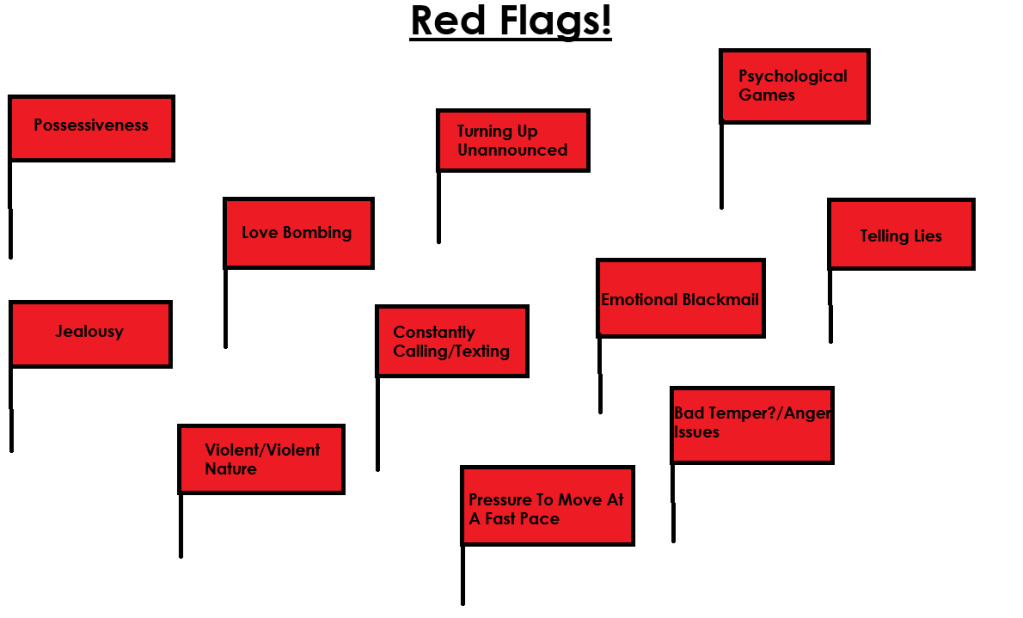
Red Flags?!
It’s really difficult to recognise toxic behaviours when we’re head over heels in love……..with the person that’s ABUSING us. Everyone else around us sees it, but we (the victim) either don’t see it, or we don’t want to see it (denial), or we are genuinely trapped in a cycle of fearing for our lives that much that we can’t leave. We hold on to that image of the perfect partner…the perfect relationship, the perfect life…we live in a sort of delusion, we live in denial. We can’t accept that the black eyes, the bruises, and the derogratory name calling, is in fact, ABUSE. We hang on to every SORRY, and we believe them when they say it won’t happen again. Emotional blackmail is a useful tool for these bullies! They manipulate us emotionally, knowing just exactly what to say to stop us from calling the police, and/or stay in the relationship, and by the time we realise or accept that what’s happening to us is abuse, it’s often too late. We’ll become seriously injured or worse, we’ll end up dead.
For me, looking back now, the RED FLAGS were there from the beginning. I now think to myself, was i just that wrapped up in the excitment of a new relationship, and the intense feelings of affection, that i chose not to give the red flags any credence? It’s SO obvious to me now though, the possessiveness, the constant calling and the love–bombing, the manipulation, and his near-constant aggressiveness towards me, the alarm bells should have been ringing instantly and loudly. You see?…the flags were there….but why did i stay? If i’d have walked–away when the WARNING signs were there, i wouldn’t have suffered as much as i did, and for as long as i did. That old hindsight again eh🤦♀️.
- Possessiveness
- Bad Temper/Anger Issues
- Emotional Blackmail
- Love Bombing
- Turning–Up (unannounced/uninvited)
- Constantly Calling/Texting
- Pressuring You (commitment, sex etc.)
- Psychological/Emotional Games
- Violent Nature
- Jealousy
- Telling Lies
Men and Domestic Abuse
Domestic abuse is usually ‘conveyed as something that only happens to women‘ (NCDV), wereas men, are almost always portrayed as, or even expected to be…the perpertrators of domestic violence and abuse. However, whilst it can be argued that domestic abuse is a gendered–crime because statistically, the majority of victims/suvivors of domestic abuse are women, and the majority of domestic violence and/or abuse is perpertrated by men. Men do in fact, suffer from domestic violence and abuse too.
Domestic abuse or violence against men is under–reported, under–recognised, and under–supported. This can be attributed to a number of things including the ‘societal expectations‘ of how men should be, and how they should behave, i.e men are typically viewed as stronger and more domineering than women.
Male victims/survivors of domestic abuse, often fail to see that they’re being abused, and/or the fear of not being believed and/or ridiculed stops them from coming forward and reporting the crime/s to the police. This can be attributed to the following;
- Domestic abuse is still viewed as something that only happens to women, and perpertrated by men only.
- The shame and stigma attached to being a male victim of domestic abuse.
- The fear of losing contact with their children.
- The fear of being labelled the perpertrator rather than the victim.
Men might experience;
- Financial Control and Exploitation.
- Physical Violence.
- Emotional and Psychological Abuse.
- False Allegations: As a form of control.
- Threats (about their housing, their children, and reputation etc.).
- Control and Monitoring.
Domestic abuse and violence against men is real…it’s here…and it’s happening, and it’s no less significant than domestic abuse and violence against women. We must therefore, speak about it more openly so that male victims/survivors of domestic abuse can access the necessary support, tools, and advice needed for their protection, their safety, and their recovery.
Why Do We Stay?
People often wonder why we just don’t leave the violent relationship and our abuser, or they assume that we can’t possibly be a victim of domestic abuse because we haven’t reported it to the police. But, if you’re lucky enough to have never experienced domestic abuse, and/or sexual violence, i understand that it must be almost impossible to grasp the psychological impacts it has on a victim/survivor. The fear of further degregation or violence alone is enough to make us stay.
There are many reasons why people find it difficult to leave an abusive relationship, this can be due to financial dependency, the fear of the unknown, or the fear of more violence etc. Therefore, it’s down to us to collectively educate those that may not be aware of the depth and gravity of the problem, and to reinforce a vital message about the dangers and risks associated with domestic abuse, coercive control, and toxic relationships.
The Danger of Leaving an Abusive Relationship.
It’s vital that you’re aware of the potential risks and dangers posed to us when leaving a violent or an abusive relationship. It’s extremely important for us to seek advice from professionals (police, DAP, National Domestic Abuse Helpline, and any other relevant authority) before leaving the relationship. This is because statisticlly, this is the most dangerous and deadly time for a victim of domestic abuse, especially women, and that we a far more likely to be attacked, and/or killed by our partner when the control they have over us is challenged, and this is usually when we choose to end the relationship.
- Between March ’18’-March ’20’, 276 women, and 86 men, were the victims of domestic homicide.
- Approximately 41% of women murdered were separated from their partners at the time of the killing, and 30% of the deaths happened within the first month of separaton, and 70% were murdered within a year.
- After separation, there’s upto a 75% increase in the severity and frequency of violence.
- When the abuse in a relationship is well-established, it makes it far more difficult to leave.
- There is 1 women on average killed every week in the UK by a partner or an ex-partner.
- There were 111 domestic-related homicides in the year ending March ’25’ (75 were women, 36 were men (67 were killed by their partner or an ex-partner).
- In the year ending March ’24’ there were 262 domestic abuse related deaths (98 were suspected suicides after experiencing domestic violence/abuse).
- It’s estimated that 30 women per day try to commit suicide after experiencing domestic abuse, and 3 women per week commit suicide.
- ‘75,000 people are at high or imminent risk of being murdered or seriously injured because of domestic abuse‘ (NCDV).
- Seperation can be long and gradual.
- We may attempt to leave the abuser several timess before being successful.
- When we leave an abusive relationship the risk of harm and/or domestic homicide increases. They may become more abusive to regain control.
Remember to talk with any relevant authority/ies if you’re thinking about, or planning to leave an abusive or violent relationship. This is because the risk of escalating abuse and violence, and/or death, substantially increases when we leave. You can speak with the National Centre for Domestic Violence in complete confidence 24/7, they can assist you with planning and executing a safe exit strategy, and discuss things such as counselling, finances and housing etc.
If you’re contemplating leaving your abuser, IT’S EXTREMELY IMPORTANT THAT THE PERSON DOESN’T FIND OUT YOU’RE LEAVING…IT LITERALLY COULD BE THE DIFFERENCE BETWEEN LIFE AND DEATH!!
“When it comes to abusive relationships, there’s so many different interwoven feelings, thoughts, and emotions at play, that the victim has difficulty differentiating between love and abuse, thus, the abuse becomes normalised“.
Naveahh Smart
I have attached a Youtube documentary, which highlights domestic abuse and the emotional aftermath.
I found the video below very interesting as it highlights emotional abuse and the impacts it has on us.
IF YOU, OR ANYONE YOU KNOW ARE IN IMMINENT DANGER CALL 999 IF/WHEN IT’S SAFE FOR YOU TO DO SO.

