When we suffer a traumatic event, it can alter the structure and functioning of our brains, including our perspectives.
Our brains are a very complex network of billions of neurons, and when we suffer trauma, our usual thoughts and processes are disrupted. This disruption creates ‘less helpful thought patterns leading to a heightened natural stress response’ (), which in turn, makes it harder for us to regulate our emotions. In this sense, we may feel trapped in these responses, for example, we may linger in an ongoing state of stress, panic and/or anxiety long after the event occured, or even throughout our lifetime.
What Is Trauma?
Trauma can be defined as ‘any disturbing experience that results in significant fear, helplessness, dissociation, confusion, or other feelings intense enough to have a long lasting effect on a persons attitudes, behaviour and other aspects of functioning’ (apa.org). Trauma is non–discriminate…it can affect anyone, at any time, and at any age.
Trauma can impact us severely, including emotionally, physically, and psychologically. It can harm our sense of safety, our self-worth, and our ability to navigate our relationships and regulate our emotions.
Traumatic Events Include: Rape, Child Abuse, Torture, War, Industial Accidents, and Natural Disasters such as Earthquakes, Typhoons, Hurricanes etc.
(THIS LIST IS BY NO-MEANS EXHAUSTIVE)
Trauma & The Brain
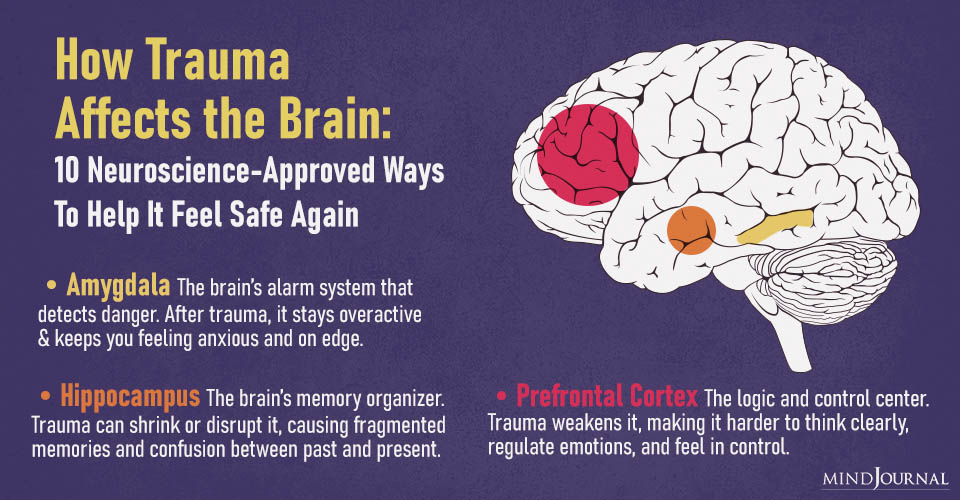
Ventromedial Prefrontal Cortex (Shrinks)
This part of the brain is responsible for emotional regulation, mood regulation, and rational thought.
Hippocampus (Shrinks)
Responsible for differentiating between the ‘past and present‘. Research shows that the Hippocampus is smaller in people that have been in combat or have suffered child sex abuse.
Amygdala (Overactive)
The Amygdala alerts the brain when there’s a sense of danger, and triggers the anxiety and fear response. ‘It causes higher-order processes like problem-solving to become underfunctioning, while processes geared towards defense become overactive’ (@laci.mcgarry). The Amygdala also forms and stores memories associated with emotional events.
Scientists say that the Amygdala and the Hippocampus play significant roles in anxiety and depression disorders.
Survival Mode
Research suggests that we have 5 automatic responses when we feel threatened, which are, fight, flight, freeze, flop, and friend. This is our bodies automatic response to keep us safe.
Fight/Flight (ancient response);
The fight and flight response is our bodies automatic physiological reaction when we feel threatened or stressed, and happens without thinking. It puts our bodies, and minds on high alert causing both physiological, and psychological changes. ‘The perception of threat activates the sympathetic nervous system and triggers an acute stress response that prepares the body to fight or flee’ (educationgateshead).
The physiological changes during the fight or flight responses release the adrenocorticotropic and corticotropin hormones which are responsible for adrenaline, noradrenaline, and cortisol.
Here are some of the feelings/changes you will experience during the fight or flight response;
Physical Changes: Increased heart rate, sweating, breathing, muscle tension, and blood pressure, dizziness/lightheadedness, shaking, nausea/butterflies, difficulty concentrating (can have negative affects).
Psychological Changes: Hypervigilance, emotional shifts (on-edge), racing thoughts, difficulty concentrating.
The 3 Stages of ‘Fight or Flight’;
Alarm System: The nervous system is ramped up in preperation to fight or flee.
Resistance System: Our bodies attempt to normalise and recover ‘from the initial flight or fight response’(carolynspring).
Exhaustive System: If the threat is reoccuring, the body eventually breaks down.
The Flop Response;
The flop response is another one of our bodies automatic survival reactions, and it’s speculated that this response is the ‘ultimate protective mechanism‘. A person might use this response when the fight, flight, freeze, or fawn tactics have not worked, they may do this to prevent additional assault/attack.
What you might feel/do during the flop response;
- Biological Shutdown: Blood pressure and heart rate decrease significantly via dorsal vagal nervous system.
- Physical Collapse: Similar to playing dead (body goes limp).
- Loss of Control: Faint, blackout, and loss of control of bodily functions.
- Mental detachment: Disorientation and complete disconnection from the situation, and emotional numbness.
- Feeling hopeless, sad, depressed, pathetic, appear disengaged.
- Missing important things i.e work, class, social settings etc.
- Apathy.
- Complete Submission.
Why do we use the flop response?;
- When our other survival responses don’t work, we use the flop response to trick the perpertrator into thinking we’re dead by mimicking death.
- Last Resort: When other responses don’t work.
- Involuntary Action: Not a concsious choice, it’s a hardwired nervous system reflex (we have no control over it).
- It may prevent further assault.
- Potentially reduces the mental impact of the situation/circumstances.
The Freeze/Fawn (Friend) Response;
These adaptions to responding to a threat/danger are far more complex and layered. These responses are often used to placate the offender when the ‘fight or flight‘ response has not worked. It’s a survival strategy usually used in an ongoing/perlonged situation. Although we use this for survival purposes, it’s not a healthy response because it can take a massive toll on the victim/survivor, which in turn, could have a detrimental affect on them in the long–run. For example, it allows for servitude, people pleasing, co-dependency on the abuser, and obsequiousness, therefore becoming ingrained in the way we think, feel, and act.
We sometimes freeze/play dead, in the hope that our attacker will leave us alone (you may feel rooted to the spot), or if that doesn’t work, we make the attacker feel important and valued with the hope they will not harm us, or harm us further, this is the fawn/friend/pleasing response.
Freeze;
- We may freeze while the brain quickly gathers information.
- If there is a threat, the freeze response ends and the ‘flight or fight‘ response switches on to protect us.
- Sometimes the best way to survive a dangerous situation is to stay still/freeze.
- Even if we want to move we can’t.
Examples of Freeze;
- Feeling numb.
- Unable to move.
- Difficulty breathing/decreased heart rate.
- Shutdown.
The Dangers of The Fawn Response;
- You lose yourself/your identity when you’re in the process of pleasing, when you’re trying to survive.
- It can become a learned way of responding.
- Repress and deny our own needs and wants.
- You can feel emptiness, loneliness, hollowness, and feeling like you don’t exist.
- Co-dependency is often the ‘result of an over-developed pleasing response. If you are continually devaluing yourself and constantly seeking validation from others, it leads to you becoming emotionally unstable and dependant on others’ (PennyHolburncoaching).
- It’s very exhausting and we use a lot of energy when we’re constantly trying to anticipate threats, and/or trying to placate others.
- We lose our ‘self-reference‘, therefore creating lots of doubts and overthinking.
- When the friend/fawn response doesn’t work we tend to engage in a pattern of self-blame (i’m not good enough), therefore, it becomes easier to ‘blame ourselves for other people’s unkindness and cruelty’ (carolynspring).
Whilst it’s important that we have these ‘built-in’ survival instincts so that we can protect ourselves from danger and/or potential threats, it’s also JUST as important that we learn to come out of these stress responses so that we don’t suffer stress-related symptoms, i.e hypervigilance, anxiety, PTSD etc.
“The human brain is both rational and instinctive. When you are exposed to danger or traumatic events, instinct takes over. It does what it needs to do to survive“.
SARAS
Stress…
- Stress makes us vigilant to potential threats/danger.
- Stress puts our minds and bodies on high alert to face the threat.
- We then focus on the threat (but we then potentially see everything else as a threat).
- We are filled with power and energy (adrenaline) to rather face the threat, or run from it.
- Stress keeps us alert until the threat has passed.
- Stress protects us from danger.
- Stress can sometimes tell us to retreat if we’re in danger of being overwhelmed.
Trapped stress is TOXIC and can cause illness and ailments.
Physical and Emotional consequences of trapped stress;
- Obesity
- Heart Disease
- Addiction
- Chronic Fatigue Syndrome
- Osteoporosis
- Anorexia Nervosa
- Sleep Troubles (insomnia, sleep apnea)
- Adrenal Fatigue
- Fibromyalgia
- Chronic Pain
- Irritable Bowel Syndrome
- Ulcerative Colitis
- Crohn’s Disease
- Osteoarthritis
- Depression
- Anxiety Attacks
- Panic Attacks
- Low Self-Esteem
- Low Self-Worth
- Helplessness and
Hopelessness - Susceptibility to certain
cancers (specifically breast
and melanoma) - Menstruation
- Child Birth
- Menopause
- Pregnancy
Trapped stress can cause relational troubles;
- Toxic relationships that
perpetuate
(or repeat). - Trouble communicating and
expressing oneself. - Inability to set clear
boundaries. - Difficulty with intimacy and
deep love. - Struggle demonstrating
and/or feeling empathy. - No desire to connect
and/or bond with others. - Parenting struggles.
Productivity problems;
- Procrastination
- Resistance
- Mental Blocks
- Trouble Focusing (“brain fog”)
The 7 Stages Of Trauma;
- Shock: Our bodies automatic response (1st response) and coping mechanism to the disbelief of what is happening. This is heightened when the attack/event is unexpected.
- Denial: We do not want to accept or come to terms with what has happened to us.
- Anger: When we bottle up or hide our true feelings, because we can’t accept or acknowledge what has happened to us, our initial response tends to be anger.
- Frustration: We question things, for example, we may ask ourselves…Would this have happened if?
- Depression: Throughout the entire process, it’s common that depression, anxiety, and panic attacks will set in ‘when you have reached the realisation of the trauma. It is important you allow the time to grieve and process the trauma you have experienced‘ (connectablelife).
- Acceptance: Although we’re not were we hope to be (mentally and emotionally), we learn to accept what has happened to us. We now begin the process of healing, and we learn to move forward.
- New Beginnings: Now we have processed the situation, we can now begin to live our lives the best way we can. Although the trauma and pain is still with us, we plan to live as happily as we possibly can.
“Embracing the future is freeing”.
Brianna Wiest
Negative Thoughts…
No matter what walk of life we come from, we’re all well adversed to negative thoughts. They might be about things that have happened in the past or the present, or we might even have negative thoughts about what the future has in store for us, and many of us during the course of our lifetime, will fleet from one negative thought to the next. But what matters is, how we learn to navigate and rationalise those negative intrusions.
When we are overwhelmed by an onslaught of negative thoughts, it triggers a ‘crisis of confidence’ within ourselves, and we then start to question everything…including our beliefs. The spiral of negative automatic thinking can appear spontaneously and frequently, and continually reinforces our negative self-esteem/self-belief, which can, and often does, affect our behaviour in many ways;
- It can affect our behaviour in relationships.
- We may become depressed.
- We may suffer from low self-esteem.
- We may isolate ourselves from the outside world e.g from family, friends, or work etc.
The 4 ways of questioning and altering negative thoughts;
- What’s the evidence? Ask yourself, do the facts of the situation back up what you think, or do they contradict it? (penna&passmore)
- What are the alternative views? Because there are many different ways to look at any experience, ask yourself, whether there is anyway to interpret the situation differently? (‘Get as many alternatives as possible and review the evidence for and against. Consider it objectively‘ (penna&passmore), and ask yourself which is more likely to be correct?
- What is the effect of thinking the way you do? How does it influence what you do and how you feel? What are the advantages and disadvantages of thinking this way? Ask yourself if there’s an alternative which will have a more positive affect?
- What thinking errors are you making? These thinking errors ‘developed in response to abuse and as a psychological way of coping with it’ (penna & passmore ltd). We no longer need to think this way!!!
Triggers…
Triggers are internal or external stimuli that ‘remind us of post-traumatic experience’ (carolynspring), and no matter how much we try to forget it and move on, it’s always there.
It’s said that triggers are like ‘psychic expolsions‘, and once ignited it can capitulate us in to the fight, flight or freeze responses. We either react with these adrenaline charged survival instincts, or by dissociation.
The good news is, that these triggers that send us into survival mode can be managed. In this sense then, triggers can and should be thought of as helpful, because they provide essential clues, snippets, and scraps of insightful information about what we’ve dissociated from. They can therefore, become ‘guides on our theraputic journey to discover what we have segragated or kept seperate from, our main consciousness, and what it is that we need to process and resolve so that we can recover and heal’ (managingtriggers).
Triggers can be;
- Sounds: Hearing certain sounds or music can take you back to the traumatic event.
- People: If someone looks physically similar to the person who harmed you/us, or if you see someone related to your/our trauma, this can trigger us.
- Thoughts: Memories and/or thoughts can bring us back to trauma.
- Smells: Certain scents/odours can trigger trauma.
- Places: Where the event happened or places similar to it can trigger trauma.
- Media: Something you see on tv, or the internet etc, can trigger us.
- Feelings: A feeling or an emotion may trigger us.
- Situations: Finding ourselves in a similar situation can trigger us.
Triggers initiate an emotional reflex and can cause us to have intrusive thoughts, nightmares, flashbacks, and panic attacks. Alongside these sypmtoms, triggers can cause us distress, dysphoria, destabilisation, and agitation, and because we have the inability to control it, in time, we must face the trauma so that we can heal at pace and in a managable manner.
Triggers may cause us to/have/become;
- Angry
- Upset
- Thrown Off-Balance
- Difficulty Paying Attention
- Irrational
- Argumentative
- Shutdown
- Oversensative
- Frightened
- Anxious
- Judging Thoughts
- Panicked
- Exhaustion
- Escape Fantasies
- Defensive
- Emotional Outbursts
- Physical Sensations
- Repeated obsessive thought patterns.
- Engage in addictive/destructive/dangerous behaviours.
- We may act out of control.
- Altered state of reality (‘emotional hijacking‘).
“Our responses seem out of proportion with what triggered us because the past experiences come flooding up“.
session notes
Facing our trauma allows us to;
- Learn self-management.
- Develop the capacity to recognise how and when we are triggered.
- Understand our emotional sensativities.
- Effectively deal with others who are triggered.
All our stories, the consequences of our stories and the way we deal with our trauma will be different in certains ways and similar in others, but there are many practical tools that we all can easily access via the internet, telephone, or support groups that can help us understand how to recognise our triggers and how to manage them.
“The cost of facing it, outweighs the cost of avoiding it“.
Managing Triggers
What Is Dissociation?
Dissociation is an overload response to trauma, it seperates us emotionally from our trauma, and sometimes, from the present moment. When escape from a dangerous situation is not possible, dissociation is another survival method that ‘ranges from a conscious decision to postpone dealing with feelings to a complete loss of touch with the present’ (session notes).
Dissociation…
- Hides our feelings.
- A sense the world isn’t real.
- Detatches us from our emotions when things become overwhelming.
- Short-Term coping mechanism.
- Creates a ‘wall between an event and the psychological consequenses of it’ (session notes).
- Helps us carry on and do what we need to.
- Develop more than 1 identity.
- Feeing little or no physical pain.
- Split awareness, to reduce perception.
- A form of denial.
- Not wanted/unhealthy.
- Lose awareness of our surroundings (short periods/long periods).
- Feel detached from our bodies, as if we’re watching ourselves from a distance.
- Disconnect from our thoughts, memories and feelings, and/or our sense of identity.
- Gaps in memory, personal details, events and forget times and dates.
- Sometimes we develop more than one identity.
- Feeling little or no physical pain.
- Vacant/Stare into space.
- Numb pain.
- Detatch from a frightening experience.
- Uncertainty about our identity/not feeling ourselves.
Dissociation can/will make us feel/experience….
- Like we have no purpose, no future, no hope, no meaning.
- Trapped by the past.
- Inherintly Doomed.
- Spiritual Crisis.
- Question Existance.
- Lack of Motivation.
- Can’t envision a future experience of pleasure or joy.
- Self-Blame: The perpertrators perspective.
- Void of genuine connection.
- Internalised Abuser.
- Internal War.
- Illusion of Control.
“Switching off from reality is a normal defence mechanism that helps a person cope during a traumatic time“.
NHS
Flashbacks
Flashbacks are involuntary, realistic, vivid, and active memories of the rape or sexual abuse, flashbacks are intrusive symptoms of PTSD and CPTSD. They can take many ‘forms and can range in intensity’ (ptsduk.org). Known as ‘mental time travel’, when we have flashbacks, it can feel like the traumatic event that capitulated us into this psychologlical turmoil, is happening all over again, we re-live it. They’re out of our control, and can happen anywhere, and at any time. Flashbacks can be a fragmented version of events or complete multi–sensory (several physiological senses), that can be accompanied by a cascade of intense emotional reactions i.e fear, anxiety, sadness etc. They can also cause physical reactions such as racing heart, detachment from self/body, and difficulty breathing etc.
When experiencing a flashback you might;
- Experience sudden changes in behaviour that align with the situation (the traumatic event).
- Be fearful and/or panic without apparent cause.
- Cry uncontrollably.
- Have a sudden pale complexion.
- Yell/Plead/Defend against something that isn’t there or percieved.
- Stare into the distance/into space.
- Not respond to others.
Sensations you may feel when experiencing a flashback;
- Disorientation/Confusion
- Dread/Doom
- Frozen
- Nausea
- Rapid Heartbeat
- Tremble
- Muscle Tension
- Sweat
- Chest Pain
- Immobile
- Anxiety
- Fear
- Panic
- Chills
- Dissociation
- Hyperventilation
Flashbacks can;
- Disrupt our daily lives.
- Stop us from functioning normally.
- Make it difficult to maintain relationships and/or jobs.
“If you are triggered (something reminds you of the trauma), the facts of what happened, the emotions associated with it and the sensations of touch, vision, sound, movement and smell, can be presented in the mind in the form of flashbacks”.
(rightnow.org)
Nightmares/Night Terrors:
Although they share some of the same characteristics, nightmares and night terrors are different in content. Nightmares are disturbing, vivid dreams that elicit strong emotional reactions when we wake, such as fear, anxiety, and/or sadness. They can be persistent, and reoccuring, and are common amongst all age groups. They also vary from person to person, and it’s suggested that reoccuring nightmares have an underlying cause…they are a manisfestation of our trauma being replayed over and over.
Night terrors, are again, intense, scary, vivid dreams, but they differ slightly to nightmares, this is because when we have nightmares, we are usually awakened immediately. Whereas, when a person suffers from night terrors, they usually sleep through them, it’s hard to wake up. When a person has night terrors, they are likely to experience extreme agitation, sleep walking, screaming, talking, or even sometimes, find themselves flailing about.
Treating anxiety and depression can ‘help resolve the thoughts and feelings that may be causing/lead to nightmares‘ (healthline).
- Medications
- Psychotherapy
- Support Groups
- Relaxation Techniques
- Regular Exercise
[We tend to remember our nightmares, but it’s rare to remember our night terrors]
PTSD (post-traumatic stress disorder)
PTSD is a complex mental health condition that’s triggered by witnessing or experiencing a traumatic event. If not treated accordingly, it can lead to flashbacks, emotional distress, severe anxiety, and/or other trauma related symptoms. People who suffer with PTSD, also suffer from intrusive thoughts, and recurring nightmares/night terrors.
Symptoms of PTSD;
- Negative thoughts/feelings/beliefs about yourself.
- Difficulty controlling your feelings and/or emotions.
- Emotionally Numb.
- Repeated headaches, stomach problems, and/or pain anywhere in the body (that has no physical cause).
- Hypervigilance (anxious, always looking for danger and potential threats).
- Disconnected from yourself and the world around you.
- Problems with relationships.
- Communication (communicate less with others).
- Avoid people and places that remind you of the traumatic event.
- Not able to fully remember the event.
We may experience;
- Explosive Anger
- Sense of Defectiveness
- Fear of Abandonment
- Mindfields
- Feelings of Betrayl
- Develop Secure Attachments
- Distrust of Compliments (echoing distrust)
“The mind replays what the heart can’t delete“.
Healthy Place
C-PTSD (complex post-traumatic stress disorder)...
The symptoms of C–PTSD, are essentally the same as PTSD, however, the causes differ. Individuals who have suffered neglect, child abuse, ongoing sexual/domestic violence, and/or have repeatedly witnessed violence and abuse are likely to develop C-PTSD.
“PTSD is not the person refusing to let go of the past, but the past refusing to let go of the person”.
Healthy Place
This video is very informative, please watch it if you can 🙂
“The instinct for immediate survival overrides longer-term rational thought“.
SARAS
Can Our Brains Recover From Trauma?
Whilst our brains are these complex super computers, responsible for the functioning of our very being, it’s important to note that it’s also a muscle that can and needs to be trained to make it strong.
What is Neuroplasticity?
Neuroplasticity is the training of new muscles in the brain, that effecively, makes it stronger. The brain is not a fixed organ, it’s ‘dynamic, flexible and continuously changing’ (sciencenewstoday). Therefore, neuroplasticity allows us to change our negative thought patterns and behaviours, in this sense then, our brains are ‘mouldable and plastic’ (term neuroplasticity), meaning that the negative changes can be reversed.
Neuroplasticity;
- The brains ‘ability to reorganise and adapt it’s structure and function in response to learning, experience, or injury’ (cleveland clinic).
- The brains capacity to change it’s neural behaviours and connections in response to development, sensory input, damage and/or new information.
- Allows the brain to function differently from it’s prior state.
- Build new pathways.
- Upgrade the human brain.
- Redistribute and modify activity across neural networks.
- Builds mental muscle: Giving it new experiences and challenging it.
- Mental exercises.
- Internal rewiring: Allowing the brain to grow.
- Allows us to develop as a person.
- Adapt to new environments and situations.
- Repeating thoughts and behaviours strengthens neural pathways.
- Is an ongoing process throught our lives.
- Aids recovery from brain injury.
“The brain you have today, is not exactly the brain you had yesterday, and will not be the same as tomorrow“.
National Library of Medicine
There are 2 main types of neuroplasticity;
- Functional Plasticity: Is the brains ability to ‘move functions from a damaged area of the brain to other undamaged areas‘ (verywellmind).
- Structural Plasticity: Is the brains ability to ‘actually change its physical structure as a result of learning‘ (verywellmind).
How to boost neuroplasticity;
- Brain Stimulation: Learn new languages, learn to play an instrument, get creative etc.
- Sleep Hygiene: Consistant sleep schedule.
- Exercise: Exercise regulary.
- Mindfulness: Practice mindfulness in a relaxed setting.
- Play board-games, card games etc.
- Adaptive changes foster skill aquisition i.e rehabilitation.
Engaging in neuroplasticity can help us erase maldaptive behaviours, thoughts and emotions. Maldaptive behaviour ‘refers to actions that are ineffective in managing stress and anxiety, often leading to further discomfort‘ (very well mind). Whilst exhibiting or engaging in maldaptive behaviours sometimes offers temporary relief from our ‘real trauma‘, it does however, prevent personal growth. For example, maldaptive behaviour can prevent us from participating in different aspects of life including interacting with family and friends, and/or avoiding people and places with the prospect of avoiding stressful or unpleasant situations.
Maldaptive behaviours;
- Elaborate Fantasies.
- Self-Harm to cope with despair/distress.
- Outbursts of explosive anger.
- Develop unhealthy eating patterns (eat too little/too much), as a coping mechanism.
- Engage in alcohol and/or drug intake as a way of managing/coping with our thoughts and emotions.
Maldaptive behaviours can also ‘entrench pathological states such as chronic pain, neurological and psychriatic conditions‘ (very well mind).
It’s important to note that there are limitations to neuroplasticity and what can be achieved. The brain is not indefinetly mallable, for example, damage to key areas of the brain may not be able to recover, therefore resulting in permanent deficits.
“Nothing else in this world can torment you as much as your own thoughts“.
Mental Health Quotes
Remember…each persons trauma will be/look different, including how we process our trauma and what triggers our traumaetc. Healing is a long and emotional process that takes time, effort, love and understanding. Our trauma is valid, we’re allowed to hurt, we’re allowed to be angry and we’re allowed to cry. Whilst others around you may not fully understand your sorrow or despair ‘YVM‘ does, you don’t have to go through this alone. We’re here to listen to your worries, your thoughts and feelings, and there are also many support groups that can offer advice about going forward and provide you with useful tools to help you heal and manage your trauma.
You should also reach out to family and friends who can provide you with emotional support. You should also contact your GP if you’re struggling, they may be able to refer you to the appropriate support that you need i.e they may refer you to a psychologist, a counsillor or other support groups. They may also prescribe you appropriate medications that may help with your anxiety, depression, or insomnia etc. Please reach out…don’t suffer in silence…your voice really does matter❤️.

